
Managing Fleet Urine Testing Without Losing Your Mind
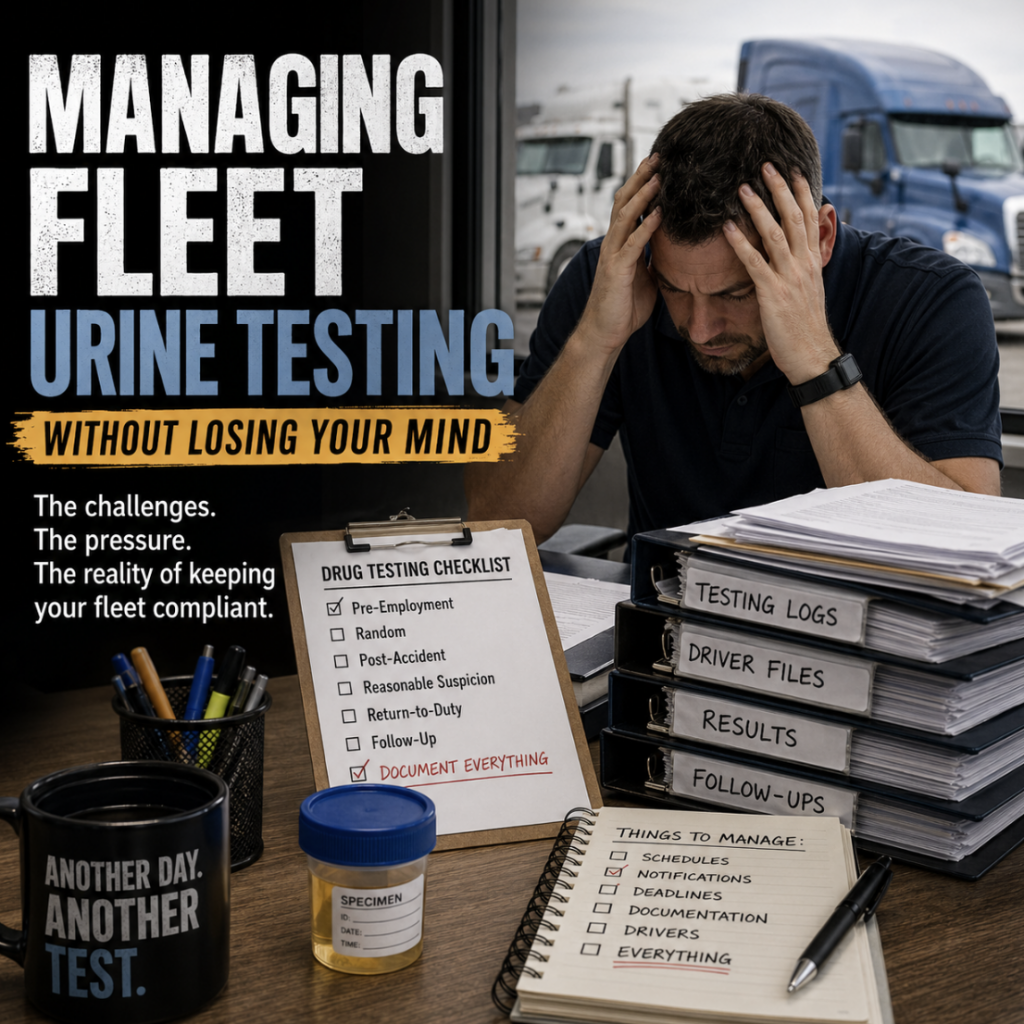
There are certain parts of fleet management that feel like logistics. There are others that feel like compliance. Then there is urine testing, which somehow manages to be both while also feeling like a full time emotional burden layered on top of everything else. Anyone who has spent time managing CDL drivers knows that drug testing is not just a regulatory requirement. It is a constant cycle of coordination, documentation, misunderstandings, and pressure that rarely lets up.
Federal requirements are clear. Drivers must be tested under specific conditions and timelines. The expectation is strict adherence, with little room for interpretation. That part is straightforward. The reality of executing it across a moving fleet of human beings is where things become far more complicated.
This is not about breaking rules or finding shortcuts. It is about acknowledging the operational strain that comes with trying to do everything correctly in a system that rarely accounts for real world variables.
Coordination That Never Stops
Managing fleet urine testing is not a one time task. It is a continuous operational loop. Drivers are dispatched across states, schedules shift without notice, and testing windows do not adjust just because a load runs late. The expectation remains fixed, even when everything else is in motion.
The administrative side alone becomes overwhelming. Tracking who is due for testing, ensuring notifications are delivered, confirming completion, and documenting every step requires constant attention. There is no margin for error because missing a step is not treated as a minor oversight. It becomes a compliance issue.
The challenge is not understanding what needs to be done. It is doing it repeatedly without interruption while managing everything else that comes with fleet operations.
Documentation Fatigue
Every test generates paperwork. Every result requires verification. Every exception needs explanation. Over time, the volume of documentation becomes its own problem. It is not just about keeping records. It is about ensuring that every record can withstand scrutiny if reviewed.
This creates a form of fatigue that is rarely acknowledged. The expectation is precision across hundreds or thousands of entries, each tied to regulatory consequences. Even when processes are in place, the repetition increases the likelihood of small errors, and small errors are not treated lightly in this context.
Drivers Are Not Static Variables
On paper, testing requirements appear simple. In practice, they involve people with unpredictable schedules, personal challenges, and varying levels of understanding about the process. A driver might be on time one day and unreachable the next. Another might misunderstand instructions or delay compliance due to circumstances outside their control.
Managing this requires constant communication. It also requires patience that is not always easy to maintain when deadlines are fixed and consequences are immediate.
There is also the reality that testing can create tension. Some drivers view it as a routine part of the job. Others view it with suspicion or frustration. That tension does not disappear. It becomes part of the daily interaction between management and drivers.
Conversations That Are Never Easy
When issues arise, the conversations that follow are rarely straightforward. Explaining requirements, addressing missed tests, and handling non compliance situations all require a level of clarity and consistency that is difficult to maintain under pressure.
In more serious cases, the situation escalates quickly. A failed test does not just affect the driver. It affects operations, scheduling, and compliance status. It also triggers a process that many drivers do not fully understand.
That process is structured and regulated, but managing it in real time is anything but simple.
Zero Margin for Error
Unlike other operational challenges, urine testing compliance does not allow for flexibility. There is no acceptable error rate. Every missed test, delayed submission, or incomplete record has the potential to escalate into a larger issue.
This creates a constant level of pressure that is difficult to ignore. It is not just about completing tasks. It is about completing them correctly every single time, regardless of external factors.
That expectation does not change when staffing is limited, when schedules shift, or when unexpected issues arise. The requirement remains the same.
Balancing Compliance and Reality
The most difficult part of managing fleet urine testing is balancing regulatory expectations with operational reality. Regulations assume a level of control that does not always exist in a moving fleet. Drivers are not always in predictable locations. Schedules do not always align with testing windows. Communication is not always immediate.
Despite this, the responsibility remains with the fleet. Adjustments have to be made. Solutions have to be found. The system does not adapt to the operation. The operation adapts to the system.
This is where frustration builds. Not because the rules are unclear, but because they are rigid in an environment that is not.
A Necessary System That Demands More Than It Acknowledges
Fleet urine testing is a necessary component of maintaining safety and compliance within the trucking industry. That is not in question. What is often overlooked is the level of effort required to manage it effectively on a daily basis.
It is not just a checklist item. It is an ongoing operational demand that requires coordination, communication, and constant attention to detail. It introduces administrative strain, complicates driver relationships, and creates pressure that extends beyond the testing process itself.
There are no shortcuts that should be taken, and none that are being suggested. The focus remains on doing things correctly. However, it is important to acknowledge that doing things correctly comes with a cost in time, energy, and operational complexity.
That reality deserves recognition, especially from those who expect flawless execution without fully understanding what it takes to achieve it.